Living the Alexander Technique Volume II by Ruth Rootberg
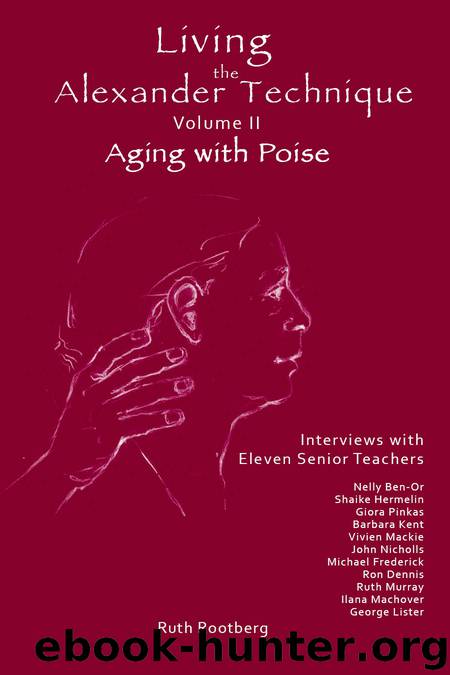
Author:Ruth Rootberg [Rootberg, Ruth]
Language: eng
Format: epub
Publisher: Off the Common Books
Published: 0101-01-01T00:00:00+00:00
Notes
1. Bioenergetic Analysis is a body-centered psychotherapy founded by Alexander Lowen (1910–2008) and rooted in the work of Wilhelm Reich (1897–1957).
2. Aldous Huxley (1894–1963) was an English writer and philosopher who studied with F. M. Alexander. A character in his novel Eyeless in Gaza is modeled after Alexander. Huxley described the Alexander Technique in Ends and Means. See note 3.
3. Aldous Huxley, “Education,” chap. 12 in Ends and Means (London: Chatto & Windus, 1937), 258–9. “So far as I am aware, the only system of physical education which fulfills all these conditions is the system developed by F. M. Alexander. Mr. Alexander has given…a technique of inhibition, working on the physical level to prevent the body from slipping back, under the influence of greedy ‘end-gaining,’ into its old habits of mal-co-ordination.…We cannot ask more from any system of physical education; nor, if we seriously desire to alter human beings in a desirable direction, can we ask any less.” (original italics)
4. The Esalen Institute is a retreat center founded in the 1960s in Big Sur, California, that has focused on the human potential movement.
5. Stafford Cripps (1889–1952) and Isobel Cripps (1911–1952) studied with F. M. Alexander and became avid supporters of the Technique. However, when FM refused to establish a society that would ensure the future of the Technique, the Crippses eventually turned to Charles Neil, a former pupil of Alexander’s, who combined physical therapy with the Technique. Neil called his practice at 18 Lansdowne Road in Holland Park the “Re-Education Centre,” but after receiving considerable support from the Crippses, he renamed it the “Dame Isobel Cripps Centre.” After Neil’s death, Walter and Dilys Carrington purchased the building and lived and taught there for many years. (See Michael Bloch, F. M.: The Life of Frederick Matthias Alexander (London: Little, Brown, 2004).
6. Edward Maisel (1917–2008) was a writer on music, tai chi, and the Alexander Technique. He compiled the chapters and wrote the introduction to The Resurrection of the Body (New York: Dell Publishing Company, 1969), a book of selections from Alexander’s writings that appeared at a time when Alexander’s works were not widely available.
7. “Ashley Place” refers to 16 Ashley Place, the location of F. M. Alexander’s teaching rooms from 1911 and residence from 1912 until his death in 1955.
8. See Eva Webb, “Diary of My Lessons in the Alexander Technique, 1947,” in The Philosopher’s Stone, ed. Jean Fischer (London: Mouritz, 1998), 15–35.
9. Goddard Binkley, The Expanding Self (London: STAT Books, 1993).
10. F. M. Alexander, The Use of the Self (London: Methuen, 1932), 64–65.
11. [email protected].
12. F. M. Alexander, The Universal Constant in Living, (London: Mouritz, 2000), 83. “The reader will now see that the technique is based upon the inhibition of the habitual wrong use—i.e., the refusal to react to a stimulus in the usual way—and that the principle of prevention is strictly adhered to from the beginning.”
13. Jiddu Krishnamurti (1895–1986) was an Indian writer, philosopher, and speaker who addressed psychological revolution, the nature of mind, meditation, inquiry, human relationships, and bringing about radical change in society.
Download
This site does not store any files on its server. We only index and link to content provided by other sites. Please contact the content providers to delete copyright contents if any and email us, we'll remove relevant links or contents immediately.
Inner Engineering: A Yogi's Guide to Joy by Sadhguru(6793)
The Power of Now: A Guide to Spiritual Enlightenment by Eckhart Tolle(5781)
Fear by Osho(4736)
Ikigai by Héctor García & Francesc Miralles(4274)
The Art of Happiness by The Dalai Lama(4130)
The Ultimate Bodybuilding Cookbook by Kendall Lou Schmidt(3945)
Yoga Therapy by Mark Stephens(3745)
The Little Book of Hygge by Meik Wiking(3693)
The Healing Self by Deepak Chopra(3578)
Why Buddhism is True by Robert Wright(3452)
The Hatha Yoga Pradipika (Translated) by Svatmarama(3341)
Being Aware of Being Aware by Rupert Spira(3276)
Shift into Freedom by Loch Kelly(3197)
Wild Words from Wild Women by Stephens Autumn(3153)
Work Clean by Dan Charnas(3122)
Happiness by Matthieu Ricard(3047)
More Language of Letting Go: 366 New Daily Meditations by Melody Beattie(3027)
Yoga Body & Mind Handbook by Jasmine Tarkeshi(2879)
Why I Am Not a Feminist by Jessa Crispin(2760)
